
Sunday, 6 July 2008

Sea Trout fishing on the Test

The other night I was lucky enough to be invited to fish the Testwood Pool on the lower Test for sea trout by Alistair Robjent of Robjents Tackle in Stockbridge. For those of you who, like me, were unaware of the migratory fishing on the Test, our most famous chalkstream actually has an increasingly larger run of salmon and sea trout every year. Alistair has been fishing the lower Test for sea trout and salmon for approximately 10 years now and knows the beat intimately, so I felt really privileged to be asked.


This is typical night time fishing which I have always found extremely exciting, and requires co ordination and stealth.... so no doubt I was going to find this quite challenging! I have also not done any slithering around in the dark since my days as a guide in Norway many years ago. There I would often spend the early hours wandering around the river blank hitting the spots I knew held these timid fish. Normally when participating in sea trout fishing of this nature one would turn up at mid day or so and scout out the river and the lies so that you would have a much better idea of the topography of the river bed, and where the likely taking spots would be. It is also your opportunity to figure out where you can cast and where you can't.


I would also recommend using tackle that you are very familiar with as everything becomes much more complicated in the dark. Well, that was not to be the case here, and we arrived on the river at about 2230... in the dark. Nothing like a challenge! So, night time drills applied here as sea trout will spook easily, even at night. It is important to keep well back from the bank, and if a torch must be used to change fly then make sure that you hold it in your mouth and point away from the river. You will have to forgive the photography as trying to take pictures in the pitch black is challenging!


For this little excursion I was using a 9'8" 7# Loomis matched with a mastery stillwater clear intermediate line on and old Hardy Ultralite Disc, 15 lbs flourocarbon and the weapon of choice down here is a snake fly of Alistair's own concoction. The extra length of rod is useful with the sharp banks and mending the line over undergrowth. The fly is tied on a single size 6 with a long silver mylar body that extends well past the shank of the hook and terminates in a wicked little flying treble. The wing is long and black extending right past the treble, and there is a small orange hackle tied in at the throat.


Alistair and Kirsty showed me the lie of the land and while Kirsty moved further down to one of her favourite spots Alistair kindly ghillied for me and directed me towards a nice little run known as "Lower Pipes". It was a bit if tricky back cast up against the trees, and as I was suing a clear line as well it was pretty tricky to gauge the distance. Eventually I found by using the thickness of the belly I could distinguish roughly how far I was casting under the trees on the following bank. The fly swung round in a fast arc and suddenly, bang! The fish hit the fly like a small jet propelled rocket, and immediately turned and made off down stream with the tip of the rod bucking wildly against the drag. I think to begin with I probably to much pressure on him and brought him up the fish up the surface. We could see the silver flank flashing in the moonlight and I found the sleep that had been trying to invade my eyelids was very quickly beaten back by a rush of adrenalin. After a reprimand from Alistair I back off the pressure a little, and after a couple of admonishing comments such as "you saltwater oik, stop hammering the fish or the fly will pull out" the fish swam freely at its own pace.


This was the fun part, for at Testwood there is a very steep dropping bank down to the water, and it was necessary to lead the flashing fish up the river a little to Alistair's waiting net. It is important not to get over excited at this point as a quick swipe with the net is very likely to know the fish off, especially with that fly treble that can easily get stuck in the net and create leverage for the fish to pull free. Luckily for me my expert ghillie waited patiently as I guided the little bar of silver over the waiting net and Alistair drew him up and away from the river. Ha Ha! My first English sea trout! An extremely good way to begin the evening. It was a lovely fish of 3 1/2 lbs, and gave me a good scrap.


It was now pitch black, and as we fished on in the darkness I could here the odd splash of a fish out there that only made the blood pulse that bit more, every cast waiting for the tug in the hand. Every so often the silence was punctuated by the screech of a hunting barn owl, or the whir of bats wings over head. Unfortunately for us that night there was a quantity of weed coming down the river which often resulted in the proverbial "weed fish" excitement, but turned out to be a disappointment. Kirtsy hooked a nice fish between 0100 and 0200, but sadly they parted company in the night. At this point the temperature did a nose dive and the activity dropped off... and so was I. I put aside my rod and followed Alistair down the bank to a favourite lie of his just above the road bridge. Fishing finished at 0300, so it was time of a last ditch effort. Alistair had explained that this stretch had a lovely shallow on the far side that sloped into a trough under the near bank covered by an overhanging tree. I cast down stream and a 60 degree angle allowing the fly to fish immediately and we both held our breath as the fly came round into the trough.


Sure enough, a fish hit the fly and wrenched line out of his hand immediately before trying to run downstream under the bridge. At the last minute Alistair calmly walked up the bank and the fish followed away from the obstacle, and again I caught that flash of liquid silver in the dark as it rolled. After a few more runs the fish rolled over and I was able to gently slide the net under and bring it to sure. A beautiful 5 lber, still with lice on its flank. There is something truly magical about being out on a river at night. The sounds and smells all around are something that we rarely experience tucked up in bed, and would encourage you to try it. As we turned and headed for the hut the soft glow of dawn could be seen sneaking up through the trees. Time to head home and grab a few hours shut eye.

Wednesday, 18 June 2008

Henry Gilbey & Nick Hart go to the American West

Henry Gilbey and Nick Hart have just arrived in Montana where they are fishing from Yellowstone Valley Ranch. Currently amidst some of the most incredible scenery on the planet amidst the elk and bison, they are find out what the fabled American trout fishing is like. I know there first day has been greeted with very high water conditions after an extremely late snow melt this year I am hoping they will get amongst the fish tomorrow.


The American West has for many years been the home of serious trout fishing, and it will be very interesting to see their opinion on how it compares to our trout fishing here in the UK. They are also testing some of the new Hardy equipment, so I will also be interested to see how it stands up.

Yellowstone Valley Ranch is one of our principal operations in Montana and offers fantastic trout fishing alongside fine accommodation. It is also a lodge totally suited to families as there are a huge variety of activities that can be organised from rafting and kayaking to horse trekking.

If you would be interested in following their progress as they careen across Yellowstone National Park then please keep an eye on Henry's Blog and Nick's Blog


Friday, 30 May 2008

Ladies Day with Upstream Dry Fly

Anna Taylor, who recently joined Aardvark McLeod on the PR and marketing side, made us aware that her husband Howard Taylor, from Upstream Dry Fly, was organising a ladies tuition day at a private lake in the Test valley. She asked if Charlotte and I might like to attend, and we of course thought this was an excellent idea and jumped at the opportunity. I have normally found that women are better students than men. They are much better at taking instruction and advice (except if you are teaching your own spouse!) and tend to really want to succeed. They normally exhibit more patience and better timing as they tend not to compensate their casting with strength.

So on Sunday the 18th May we convened at the Peat Spade Inn outside Stockbridge at the appointed time for morning coffee. After the miserable day previously we were met with glorious sunshine and looked forward to the day ahead. Approximately 25 ladies arrived, and after a brief orientation as to the day’s timetable by Howard we left in Convoy for the lake. Howard was joined by Brett O’Connor and a couple of other instructors. Howard is a member of the Hardy Greys Academy, and all the equipment needed was provided by Hardy Greys, as well as of a couple of their female instructors from Alnwick.

Once on the lake we busied ourselves tackling up 25 rods, and at this stage wool was tied to the end of the line to prevent anyone hooking themselves immediately. Brett then gave an excellent demonstration on the basics of fly casting and everyone went away to practice. I tried to be helpful by offering advice and demonstrations, finding the principal faults were too much wrist, as often is the case. Many also extend the arm too much instead of allowing the rod to do the work. However, after a short time everyone was getting along nicely and we did not spend too much time running back into the undergrowth untying leaders in trees.

Brett then moved on to demonstrating the roll cast before moving into the back cast, and after these basic two casts had been mastered flies were produced and the students began to actually fish. I am proud to say that the first person to hook a fish was Charlotte who hooked and landed two in fairly quick succession. Even though she has been dispatched to catch sail fish on the fly in Guatemala and caught bonefish in Belize these were the first ever trout that she had caught. It was also an opportunity for her to christen her new trout outfit, a Greys Greyflex 9’ 5/6# with matching reel. It has a lovely smooth action making it ideal for those starting to trout fish.


As the afternoon wore on the fish began to rise freely to emergers and any terrestrials that happened across the lake. At this point a few Mayfly began to hatch against the trees and wafted down across the surface making the trout go mental. As I wandered round the corner of the lake to where a small stream entered and created a current I found Sarah Fitzpatrick from the Field Magazine casting across it when a large brown trout came up and nailed a Mayfly off the surface. We both stared at it for a minute before I rushed up and asked her what fly she was using. The small Montana was quickly replaced by an up wing Mayfly from my box doused in Gink to keep it afloat.

“Are we going to catch that fish?” she asked. “Absolutely” I replied full of confidence. The small stream created an excellent flow in the lake, and a number of fish were taking Mayfly being swirled down the current before it petered out into still water again. Sarah had never caught a trout either. She cast the fly accurately, but not quite far enough. “further out and a little higher in the current...” I added helpfully. After several more casts the fly swung round in the current and a good sized rainbow slowly rose to the surface, opened its mouth and engulfed the fly before continuing its roll to the depths again. “Strike!” I yelled, the line went tight and the fish was on.. It immediately jumped producing squeaks of excitement from Sarah before Brett came pounding along the bank with a net.

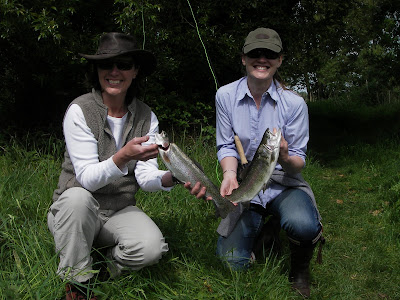
Now, this fish really did not want to come in. I showed Sarah the concept of side strain, and each time the fish would move in one direction she would apply pressure in the opposite way. As this was her first fish both Brett and I were working hard to ensure she did not lose it! Eventually after a nail biting fight she moved backwards from the bank and slipped the fish over the waiting net.. Great! Her first trout, and on a dry Mayfly! Excellent! Then it was back to the Peat Spade for a fabulous late lunch. It was a really great day, and I hope something that Howard will repeat. For too long ladies have been left on the bank so to speak, and most women I know who have started and carried on with fishing tend to put other fishermen to shame.
Giant permit caught at the Isle of Youth, Cuba

Richard Ward recently returned from a two week trip in Cuba with Jack Simpson, and beat his personal best with a Grand Slam featuring a permit estimated at 36 lbs! Richard has been to Cuba many times and this particular adventure began at the end of April. Along with many other members of Jack’s group Richard booked La Tortuga in the Jardines de la Reina for the first week followed by a second week at the Hotel El Rancho on the Isle of Youth.

The first week at Jardines de la Reina required early starts to get amongst the rolling tarpon. Although the week was not as productive as some in past years, there were numerous migratory tarpon located outside the reef during the day daisy chaining and engaged in spawning rituals. A number of these would come into the shallower water to keep fishermen alert and Richard managed to boat tarpon every day to about 90 lbs.

As the second week at the Isle of Youth progressed it was evident that the fishing was improving. All members of the party landed fish in the 70 – 90 lbs category. On the 4th May Richard had hooked nine tarpon and landed seven before stopping for lunch. Lady luck was smiling down on him as it is normal to hook many more than you manage to bring alongside the boat. All these fish were in the same size bracket as previously , and all caught on the flats on either floating or intermediate lines – classic tarpon fishing.

After lunch Richard and his guide Coki decided to go in search of permit, the fish that we all find most frustrating. While polling along the coral drop offs they eventually came across a group of six permit slowly cruising high in the water column. These fish were big, and Richard began to sweat. He made some casts to no avail, and despite changing flies and densities of lines he could not induce any interest. During one of these drifts down the edge, two fish of immense size made an appearance that Coki (who has caught more permit than anyone in Cuba) estimated at near 50lbs. After perusing through the fly box and trying every combination Coki voiced that the tide was wrong for these fish, and if they headed back to the same spot the following morning on the correct stage of the tide they would have a better chance.

The following morning they were out early, and there were tarpon rolling freely. Seeing a tarpon roll approximately 35 yards away Richard cast an “Orange Dillon” on an intercept course. Having allowed the fly to sink a little one slow strip later the fish slowly moved up and engulfed the fly. He set the hook as it turned away and all hell broke loose as it put holes in the ocean. He gave it some stick and after a hard fight they released a Tarpon of about 60lbs. Quickly afterwards he cast at and hooked another fish of about 70 lbs on a shallow flat of between five and nine feet in depth. The “Black Death” had been responsible for the take in this instance, and after a battle of twenty minutes or so this fish was also carefully released. A good beginning to the morning!

At this point Coki announced that the tide and wind were now correct for permit and the pair headed back to the same area they had encountered the monsters the day before. Coki began to poll the boat along the edge and having found a pair of disinterested fish found a further group of six. Coki had advised to switch to a floating crab, and while changing the fly Richard listen to his instructions on how to present the fly. Th line sung out through the rings and he managed to present the fly to within three feet of the lead fish. It instantly reacted, but before the fish could take the fly an even larger permit charged it out of the way and nailed the crab. A firm strip strike followed by a further three when he managed to get it on the reel and the fight commenced. For over an hour the fish made blistering runs, some for deep water, others for coral heads. The permit picked up weed on the line and tested his gear to the absolute limit. Even as he shorted his line and applied maximum side strain to pull the fish towards the waiting hands of Coki he still did not quite realise how large it was. Coki caught hold of the fish with a strong hand, and immediately began to jabber about this being the largest permit landed in Cuba on the fly. What a fish! After some quick photos the fish was carefully revived and released.


Right, tarpon and permit achieved, only the bonefish needed for a Grand Slam! Richard changed to his bonefish rod and further up the flat in the shallower water was a single bonefish. Casting a small crab pattern at the fish Richard gave the fly two small strips and the bonefish turned and immediately hovered up his offering. A couple of strip strikes had it headed for the horizon in an attempt to relieve him of all of his backing. After two more long runs well into the back they he had the fish to hand. A cracking fish of about 5 ½ lbs and the perfect way to finish the Grand Slam. This was Richard’s seventh Grand Slam in Cuba, but one he will always remember! He did spend the remaining the 2 ½ hours looking for a snook in a world class snook fishery to complete the Super Grand Slam, but to no avail... well, that’s fishing!

Wednesday, 7 May 2008

A quick flick in Norway

This weekend I have hopped over to Norway for a family function with my wife. The first question everyone asks is are you going fishing? Well, that all depends on what I can get away with! It is too early for the salmon, but by all reports from friends here the snow fall looks set for a good season. However, there is so many more places to cast a fly in this country than just the salmon rivers.


My brother in law, Kenneth Erdal, came to my rescue by turning up with a car load of gear and said “Good to see you! Let’s go fishing!” That first evening we popped down to a lake literally just down the road from Lindäs. (Lindäs is about 45 minutes outside Bergen where my parents in law live.) We greeted by the sight of rings of rising trout all over the place. The warming sun was slowly slipping down the sky as we cast in vain at the persistent wild trout, but unfortunately could not match the hatch. I think they were taking a very small midge off the surface, and we had nothing small enough to imitate them. Never mind, it was a perfect way to spend a few pleasant hours casting a fly, having a quiet beer, and just enjoying being in such a beautiful place. As the sun slipped below the mountains the temperature dropped sharply, the hatch finished, the rings became infrequent and we headed home.

This morning Kenneth suggested a little expedition to find a sea trout. Again, there are more areas to find sea trout than just the rivers. We drove north, caught a ferry and made our way down to a stunning small fjord that has a river flowing into the entrance. It’s location shall remain a secret... It turns out that the fjord around the entrance has a great head of sea trout that cruise around the margins until the tide turns and they can run the river. As they are still in the sea they feed aggressively.. or so we hoped! Kenneth hit one quite quickly, to my surprise, and I had a couple of knocks on a black woolly bugger. We did not fish for more than a couple of hours, but the tide was pushing out fast so we were there at the wrong time.


Even though this is a bit of a pathetic tale of woe in that we did not catch much, it goes to show that if you think outside the box sometimes you can find some good fishing. I think the next time I come over I will bring my float tube as that will certainly expand my ability to fish locally. Even though it was not too productive I have still managed to scratch my itch!

Tuesday, 29 April 2008

East Anglian CLA Game Fair

Last Friday we headed up to Norfolk to exhibit at the East Anglian CLA Game Fair. the show was located at the Norfolk showground just outside Norwich, and is ideal as it is a permanent show ground. This is a relatively new show which has been running for about five years and is growing year on year, so we thought it might be a good chance to meet some of the East Anglian fishing fraternity. I grew up in Norfolk so I really enjoyed bumping into many familiar faces and many new ones.


Although shows are hard work I find them immensely rewarding as I have the opportunity to meet people face to face and show them some of our destinations first hand. I also love meeting our existing clients so that we can both put faces to names. I personally find it much easier to talk to someone who I have met rather than a disembodied voice over the phone! Funnily enough most of those that came to see us were interested in saltwater fishing, especially the outer islands in the Seychelles. That 50lbs GT shot grabs more people as they walk by than any other.


Charles Jardine was doing his usual crowd pleasing demonstrations, and it never ceases to amaze me how he manages to pull in a crowd, and often of people who don't fish. It was great to catch up with him as I had not seen him in a little while. I would really like to take this opportunity to thank all those that came to see us, and for your continued support.

Tuesday, 22 April 2008

What do you do with your kit when you get home?

So, you have just had the most awesome trip, and you have caught stacks of fish. You are flying out tomorrow morning early, and you have got to pack all the kit you brought with you back into the space you brought it out in. The worst part of the trip.

The one thing I have learnt over the years is that throwing all your gear in your bag, wet, perhaps salty with the thought in your head that you are going to sort it out when you get back is a really bad idea. It never happens. When you finally get home and you are knackered the last thing you feel like doing is to get it all out again, clean it all, and then put it away. The best thing to do is to clean as much as you can on site before you fly. A nice shower does the job perfectly.

As I pack up my clothes I put all my gear in the shower while to soak in freshwater, and then lay it all out on a towel on the bed. Make sure you keep similar rods separate as it is very difficult to see the difference between and 8 weight and a 9 weight. I wipe all rods with a wet cloth including the rings to remove grime or salt, leave it to drip dry, and then dry them down. Leave them to dry as long as you can so the cork can dry. NEVER put rods away wet as the cork will rot, and the damp can get under the varnish and make it bubble off the blank. Also make sure the cloth bags that they are going back into are dry.

While I am doing this I fill up the sink and having loosened off all the drag drop the reels in and leave them to soak. Again, especially with saltwater, the salt gets right into the backing and can corrode the reel under it. If you have used the reel covers to cover the reels in the boat then make sure they are clean and dry as well. Then pull the reels out and let them dry on the towel as well. I also throw in the sink all the flies I have used, and any ironmongery such as forceps, leathermens and pliers. I also wash off spools of leader that have been drenched as they can get encrusted with salt, making them sticky for the future. I know this all sounds overly complicated, but once you have your system it takes very little time, and means the next time that you come to pull your gear out of the cupboard it is ready to go.

Finally, when you get home and are getting ready to put everything away throw the whole lot in the airing cupboard to dry it out completely. I have found mildew on my backing before, and this can make it break under strength. I also find the a little WD40 oil can go along way to preserving your ironmongery. It is also a moisture emulsifier, and will help protect them in the future. This may seem a little pedantic to some, but much of the equipment that we use these is VERY expensive, and simple steps like this can go a long way to prolonging their life.