
Friday, 30 May 2008

Ladies Day with Upstream Dry Fly

Anna Taylor, who recently joined Aardvark McLeod on the PR and marketing side, made us aware that her husband Howard Taylor, from Upstream Dry Fly, was organising a ladies tuition day at a private lake in the Test valley. She asked if Charlotte and I might like to attend, and we of course thought this was an excellent idea and jumped at the opportunity. I have normally found that women are better students than men. They are much better at taking instruction and advice (except if you are teaching your own spouse!) and tend to really want to succeed. They normally exhibit more patience and better timing as they tend not to compensate their casting with strength.

So on Sunday the 18th May we convened at the Peat Spade Inn outside Stockbridge at the appointed time for morning coffee. After the miserable day previously we were met with glorious sunshine and looked forward to the day ahead. Approximately 25 ladies arrived, and after a brief orientation as to the day’s timetable by Howard we left in Convoy for the lake. Howard was joined by Brett O’Connor and a couple of other instructors. Howard is a member of the Hardy Greys Academy, and all the equipment needed was provided by Hardy Greys, as well as of a couple of their female instructors from Alnwick.

Once on the lake we busied ourselves tackling up 25 rods, and at this stage wool was tied to the end of the line to prevent anyone hooking themselves immediately. Brett then gave an excellent demonstration on the basics of fly casting and everyone went away to practice. I tried to be helpful by offering advice and demonstrations, finding the principal faults were too much wrist, as often is the case. Many also extend the arm too much instead of allowing the rod to do the work. However, after a short time everyone was getting along nicely and we did not spend too much time running back into the undergrowth untying leaders in trees.

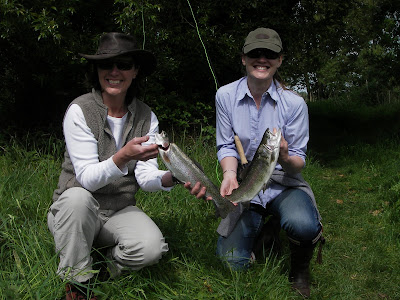
Brett then moved on to demonstrating the roll cast before moving into the back cast, and after these basic two casts had been mastered flies were produced and the students began to actually fish. I am proud to say that the first person to hook a fish was Charlotte who hooked and landed two in fairly quick succession. Even though she has been dispatched to catch sail fish on the fly in Guatemala and caught bonefish in Belize these were the first ever trout that she had caught. It was also an opportunity for her to christen her new trout outfit, a Greys Greyflex 9’ 5/6# with matching reel. It has a lovely smooth action making it ideal for those starting to trout fish.


As the afternoon wore on the fish began to rise freely to emergers and any terrestrials that happened across the lake. At this point a few Mayfly began to hatch against the trees and wafted down across the surface making the trout go mental. As I wandered round the corner of the lake to where a small stream entered and created a current I found Sarah Fitzpatrick from the Field Magazine casting across it when a large brown trout came up and nailed a Mayfly off the surface. We both stared at it for a minute before I rushed up and asked her what fly she was using. The small Montana was quickly replaced by an up wing Mayfly from my box doused in Gink to keep it afloat.

“Are we going to catch that fish?” she asked. “Absolutely” I replied full of confidence. The small stream created an excellent flow in the lake, and a number of fish were taking Mayfly being swirled down the current before it petered out into still water again. Sarah had never caught a trout either. She cast the fly accurately, but not quite far enough. “further out and a little higher in the current...” I added helpfully. After several more casts the fly swung round in the current and a good sized rainbow slowly rose to the surface, opened its mouth and engulfed the fly before continuing its roll to the depths again. “Strike!” I yelled, the line went tight and the fish was on.. It immediately jumped producing squeaks of excitement from Sarah before Brett came pounding along the bank with a net.

Now, this fish really did not want to come in. I showed Sarah the concept of side strain, and each time the fish would move in one direction she would apply pressure in the opposite way. As this was her first fish both Brett and I were working hard to ensure she did not lose it! Eventually after a nail biting fight she moved backwards from the bank and slipped the fish over the waiting net.. Great! Her first trout, and on a dry Mayfly! Excellent! Then it was back to the Peat Spade for a fabulous late lunch. It was a really great day, and I hope something that Howard will repeat. For too long ladies have been left on the bank so to speak, and most women I know who have started and carried on with fishing tend to put other fishermen to shame.
Giant permit caught at the Isle of Youth, Cuba

Richard Ward recently returned from a two week trip in Cuba with Jack Simpson, and beat his personal best with a Grand Slam featuring a permit estimated at 36 lbs! Richard has been to Cuba many times and this particular adventure began at the end of April. Along with many other members of Jack’s group Richard booked La Tortuga in the Jardines de la Reina for the first week followed by a second week at the Hotel El Rancho on the Isle of Youth.

The first week at Jardines de la Reina required early starts to get amongst the rolling tarpon. Although the week was not as productive as some in past years, there were numerous migratory tarpon located outside the reef during the day daisy chaining and engaged in spawning rituals. A number of these would come into the shallower water to keep fishermen alert and Richard managed to boat tarpon every day to about 90 lbs.

As the second week at the Isle of Youth progressed it was evident that the fishing was improving. All members of the party landed fish in the 70 – 90 lbs category. On the 4th May Richard had hooked nine tarpon and landed seven before stopping for lunch. Lady luck was smiling down on him as it is normal to hook many more than you manage to bring alongside the boat. All these fish were in the same size bracket as previously , and all caught on the flats on either floating or intermediate lines – classic tarpon fishing.

After lunch Richard and his guide Coki decided to go in search of permit, the fish that we all find most frustrating. While polling along the coral drop offs they eventually came across a group of six permit slowly cruising high in the water column. These fish were big, and Richard began to sweat. He made some casts to no avail, and despite changing flies and densities of lines he could not induce any interest. During one of these drifts down the edge, two fish of immense size made an appearance that Coki (who has caught more permit than anyone in Cuba) estimated at near 50lbs. After perusing through the fly box and trying every combination Coki voiced that the tide was wrong for these fish, and if they headed back to the same spot the following morning on the correct stage of the tide they would have a better chance.

The following morning they were out early, and there were tarpon rolling freely. Seeing a tarpon roll approximately 35 yards away Richard cast an “Orange Dillon” on an intercept course. Having allowed the fly to sink a little one slow strip later the fish slowly moved up and engulfed the fly. He set the hook as it turned away and all hell broke loose as it put holes in the ocean. He gave it some stick and after a hard fight they released a Tarpon of about 60lbs. Quickly afterwards he cast at and hooked another fish of about 70 lbs on a shallow flat of between five and nine feet in depth. The “Black Death” had been responsible for the take in this instance, and after a battle of twenty minutes or so this fish was also carefully released. A good beginning to the morning!

At this point Coki announced that the tide and wind were now correct for permit and the pair headed back to the same area they had encountered the monsters the day before. Coki began to poll the boat along the edge and having found a pair of disinterested fish found a further group of six. Coki had advised to switch to a floating crab, and while changing the fly Richard listen to his instructions on how to present the fly. Th line sung out through the rings and he managed to present the fly to within three feet of the lead fish. It instantly reacted, but before the fish could take the fly an even larger permit charged it out of the way and nailed the crab. A firm strip strike followed by a further three when he managed to get it on the reel and the fight commenced. For over an hour the fish made blistering runs, some for deep water, others for coral heads. The permit picked up weed on the line and tested his gear to the absolute limit. Even as he shorted his line and applied maximum side strain to pull the fish towards the waiting hands of Coki he still did not quite realise how large it was. Coki caught hold of the fish with a strong hand, and immediately began to jabber about this being the largest permit landed in Cuba on the fly. What a fish! After some quick photos the fish was carefully revived and released.


Right, tarpon and permit achieved, only the bonefish needed for a Grand Slam! Richard changed to his bonefish rod and further up the flat in the shallower water was a single bonefish. Casting a small crab pattern at the fish Richard gave the fly two small strips and the bonefish turned and immediately hovered up his offering. A couple of strip strikes had it headed for the horizon in an attempt to relieve him of all of his backing. After two more long runs well into the back they he had the fish to hand. A cracking fish of about 5 ½ lbs and the perfect way to finish the Grand Slam. This was Richard’s seventh Grand Slam in Cuba, but one he will always remember! He did spend the remaining the 2 ½ hours looking for a snook in a world class snook fishery to complete the Super Grand Slam, but to no avail... well, that’s fishing!

Wednesday, 7 May 2008

A quick flick in Norway

This weekend I have hopped over to Norway for a family function with my wife. The first question everyone asks is are you going fishing? Well, that all depends on what I can get away with! It is too early for the salmon, but by all reports from friends here the snow fall looks set for a good season. However, there is so many more places to cast a fly in this country than just the salmon rivers.


My brother in law, Kenneth Erdal, came to my rescue by turning up with a car load of gear and said “Good to see you! Let’s go fishing!” That first evening we popped down to a lake literally just down the road from Lindäs. (Lindäs is about 45 minutes outside Bergen where my parents in law live.) We greeted by the sight of rings of rising trout all over the place. The warming sun was slowly slipping down the sky as we cast in vain at the persistent wild trout, but unfortunately could not match the hatch. I think they were taking a very small midge off the surface, and we had nothing small enough to imitate them. Never mind, it was a perfect way to spend a few pleasant hours casting a fly, having a quiet beer, and just enjoying being in such a beautiful place. As the sun slipped below the mountains the temperature dropped sharply, the hatch finished, the rings became infrequent and we headed home.

This morning Kenneth suggested a little expedition to find a sea trout. Again, there are more areas to find sea trout than just the rivers. We drove north, caught a ferry and made our way down to a stunning small fjord that has a river flowing into the entrance. It’s location shall remain a secret... It turns out that the fjord around the entrance has a great head of sea trout that cruise around the margins until the tide turns and they can run the river. As they are still in the sea they feed aggressively.. or so we hoped! Kenneth hit one quite quickly, to my surprise, and I had a couple of knocks on a black woolly bugger. We did not fish for more than a couple of hours, but the tide was pushing out fast so we were there at the wrong time.


Even though this is a bit of a pathetic tale of woe in that we did not catch much, it goes to show that if you think outside the box sometimes you can find some good fishing. I think the next time I come over I will bring my float tube as that will certainly expand my ability to fish locally. Even though it was not too productive I have still managed to scratch my itch!

Tuesday, 29 April 2008

East Anglian CLA Game Fair

Last Friday we headed up to Norfolk to exhibit at the East Anglian CLA Game Fair. the show was located at the Norfolk showground just outside Norwich, and is ideal as it is a permanent show ground. This is a relatively new show which has been running for about five years and is growing year on year, so we thought it might be a good chance to meet some of the East Anglian fishing fraternity. I grew up in Norfolk so I really enjoyed bumping into many familiar faces and many new ones.


Although shows are hard work I find them immensely rewarding as I have the opportunity to meet people face to face and show them some of our destinations first hand. I also love meeting our existing clients so that we can both put faces to names. I personally find it much easier to talk to someone who I have met rather than a disembodied voice over the phone! Funnily enough most of those that came to see us were interested in saltwater fishing, especially the outer islands in the Seychelles. That 50lbs GT shot grabs more people as they walk by than any other.


Charles Jardine was doing his usual crowd pleasing demonstrations, and it never ceases to amaze me how he manages to pull in a crowd, and often of people who don't fish. It was great to catch up with him as I had not seen him in a little while. I would really like to take this opportunity to thank all those that came to see us, and for your continued support.

Tuesday, 22 April 2008

What do you do with your kit when you get home?

So, you have just had the most awesome trip, and you have caught stacks of fish. You are flying out tomorrow morning early, and you have got to pack all the kit you brought with you back into the space you brought it out in. The worst part of the trip.

The one thing I have learnt over the years is that throwing all your gear in your bag, wet, perhaps salty with the thought in your head that you are going to sort it out when you get back is a really bad idea. It never happens. When you finally get home and you are knackered the last thing you feel like doing is to get it all out again, clean it all, and then put it away. The best thing to do is to clean as much as you can on site before you fly. A nice shower does the job perfectly.

As I pack up my clothes I put all my gear in the shower while to soak in freshwater, and then lay it all out on a towel on the bed. Make sure you keep similar rods separate as it is very difficult to see the difference between and 8 weight and a 9 weight. I wipe all rods with a wet cloth including the rings to remove grime or salt, leave it to drip dry, and then dry them down. Leave them to dry as long as you can so the cork can dry. NEVER put rods away wet as the cork will rot, and the damp can get under the varnish and make it bubble off the blank. Also make sure the cloth bags that they are going back into are dry.

While I am doing this I fill up the sink and having loosened off all the drag drop the reels in and leave them to soak. Again, especially with saltwater, the salt gets right into the backing and can corrode the reel under it. If you have used the reel covers to cover the reels in the boat then make sure they are clean and dry as well. Then pull the reels out and let them dry on the towel as well. I also throw in the sink all the flies I have used, and any ironmongery such as forceps, leathermens and pliers. I also wash off spools of leader that have been drenched as they can get encrusted with salt, making them sticky for the future. I know this all sounds overly complicated, but once you have your system it takes very little time, and means the next time that you come to pull your gear out of the cupboard it is ready to go.

Finally, when you get home and are getting ready to put everything away throw the whole lot in the airing cupboard to dry it out completely. I have found mildew on my backing before, and this can make it break under strength. I also find the a little WD40 oil can go along way to preserving your ironmongery. It is also a moisture emulsifier, and will help protect them in the future. This may seem a little pedantic to some, but much of the equipment that we use these is VERY expensive, and simple steps like this can go a long way to prolonging their life.

Monday, 21 April 2008

Los Roques, Venezuela, Day 6

As light slowly dawned on our last day the wind returned again, but not the grey clouds. By this stage in the week it takes everyone a little longer to get going in the morning and more coffee is consumed than usual. For those who have not yet found what they have been searching for such as a specimen bonefish, elusive permit or large jack the last day represents that last chance to achieve goals.


As usual the small fleet of boats disappeared into the depths of the national park. Kirsty and Alistair especially were on the track of some large fish as they had been a little unlucky in terms of numbers up to this point. This had really been as Kirsty had been fishing her heart out to catch her first bonefish all by herself with out any help, and had worked hard at it. Alistair in his efforts to make her dream reality had asked the guides through most of the week to concentrate their efforts on achieving this goal. Finally after some very hard work Kirsty triumphed producing an excellent bonefish of approximately 5 lbs stalked on the flats and cast for her all by herself. So after this Alistair was going to get stuck in. He proceeded to take 5 fish off the flats in fairly quick succession, most of them on the pancake flats which was no mean achievement in the wind.

While standing on the edge of the flat his guide Efren saw an approaching school of blue runner, and instructed Alistair to throw out a long line. "Further" he said. Alistair stripped more line of the reel, wound up his Loomis Crosscurrent and chucked it out in the direction of the school. He looked at Efren. "Further" came the reply. Alistair now pulled off a couple of handfuls of backing, and after a couple of fast hauls shot the lot out of the rings. Strip, strip, bang! He was attached to a good sized blue runner on his 8 weight and in for a battle! The fish strained against his line, and Alistair got a taste of how powerful these small Jack/ tuna cross fish are. After about a 15 minute fight he managed to land it. Kirsty topped this off with a couple of fine barracuda on the spin gear to finish off with.

Will and Jamie had headed off to Crasqui with with Jesus and fished the white sand beach up towards the beer shacks. The bones were really finicky in calm clear water but he managed to hook one after a frustrating first half hour of near misses. Unfortunately after all that effort it headed out into deeper water and was promptly consumed by a 20lb cuda! Very exciting stuff, but slightly irritating none the less. Jamie then stalked a good bone off the beach of about 3.5lb on minnows. Jesus then took them off to one of the lagoons to try their luck for some baby tarpon and snook, and also to evade the powerful winds. After an hour or so Will landed a good bone of about 4 lbs with a 15 yd up wind cast that for once went according to plan. The small band then took off into the back country and did about a mile through the bush to get to a nice beach and flats. Will fished one side of a spit while Jesus led Jamie down the other. After loosing another bonefish and landing one more Will then landed a nice little pompano. A tougher day than before, but still rewarding.


Rick's final day started out with so much promise. Fish were thick as thieves, and he had never seen a flat like the first one. Unfortunately his streak of luck/skill was waning... After a 30 minute wade with Cayito, they came upon the first group of bonefish and with his first cast hooked one... Sadly as it ran, it wrapped the line around a mangrove shoot and quickly popped the line... About two minutes later he hooked into another one and either had foul hooked it, or did not set the hook as well as he perhaps should have, after a brief fight, he was off. Not ten minutes later, he hooked into yet another bone, but a failure of the leader saw that one slip through his fingers. By this stage Rick was beginning to wonder if his luck had run out. However the intrepid pair then came upon the sweetest of honey pots. Rick managed to hook and land his first fish about 20 minutes later and from there, it was game on. He landed another two in quick succession, all good sized, between 3-5lbs. He remarked "the fish were as thick and friendly as any I had come across." The schools just kept coming in waves and this is despite the fact that there were many natural predators in the area (he saw two lemon sharks and a few sizable cuda). This brought his morning session to a total of five fish off that flat.

After a brief lunch it was back onto the flats. For the afternoon session locating the fish proved a little more difficult. After the run he had experienced with the flat in the morning he thought it was just fate balancing out the world. They went to three more flats and only managed to land one more fish for the afternoon. In the fading light, he came across some tailing fish just off the beach, but they expressed no interest in the gummy minnow that we were using. With that, we returned to the boat, pulled up anchor and made for home for a well deserved cold beer.

That evening I organised a casting competition for the guides on the dock. We each chipped in $10 making the total pot $100 to the winner of the longest cast. I always enjoy this as it gives the guides a chance to show us how it is done, and also the clients an opportunity to spike fun at the guides for giving them such a hard time during the week. To many taunts of "more to the left!" and "the fish is further our!" our winner was Howard, the dark sheep who came from now where to beat Raphael the favourite. After a few more beers and some good stories we said our goodbyes and thank yous to our friends, and turned out noses back towards the posada and our final supper at Acuarela. Most of us beat a reasonably hasty retreat to bed that night as we had a very early start the next morning. However, I discovered later that some members of the party had snuck out, discovered one of the guides who shall remain anonymous, headed to the nearest bar and consumed a massive amount of beer. Luckily the guide was not working for the next couple of days, but I laughed hugely in the morning when they we still nicely intoxicated.

Well, we are sad to be heading back to the world of civilisation and to leave this little island piscatorial paradise. We have had a fantastic trip, and I am already planning to return next year to see all my friends again. Los Roques has been and still is one of the finest bone fisheries on this planet, and with some exiting developments next year will continue to be so for many years to come. Roll on next year!

Thursday, 17 April 2008

Los Roques, Venezuela, Day 5

Right out on the north western edge of the archipelago is a very long beach flat key called Carenero. This and the small keys of Lanqui and Mosquitoqui have long been a favourite of mine. Will joined Elisabeth and I and together with Jesus our guide we set off rapidly after breakfast. It is one of the longest runs they do here, and takes approximately 45 minutes to get out there. The sun was shining, there was not too much wind, and our spirits were high.


On arrival there is a small island just above this area called Isla Felipe O Brujusqui that has a wonderful pancake flat running around it and is often the home of some really good sized fish. This was also the day I had chosen to try out my new toy, an underwater housing for my video camera. Jesus led across the island, through some tightly packed mangroves and we popped out on the flat... with a strong wind directly in our faces.. Will moved up wind towards the top end of the island with Jesus, and I followed along as camera man. Suddenly out of the corner of my eye I spotted movement on the turtle grass and a couple of very large bones became visible, rooting up wind and sticking their tails up every so often. A very difficult up wind back hand cast.... Go on Will! Hauling very hard to make the line punch into the wind the fly came down very hard and the fish spooked. We kept moving.


Swapping over the other side of the channel to Lanqui Will quickly hooked up off the white sand beach on a hot flash minnow. He humoured me and allowed me to chase it around a bit with the camera before we quickly landed it and released it. A nice fish of about four pounds and a good way to start the day. We moved around the corner and Jesus stopped Will with his hand and pointed. Upwind of him in the deeper water were two or three really large fish. He threw a high back cast and a low forecast, tucking the tight loop into the wind. The fish slammed the fly like a ton of bricks and ripped line of his reel and well into the backing before he brought it under control. He expertly used the angles on it and on landing it hit 7lbs on the boga grip. His biggest ever bonefish!

After a quick wade across the channel looking for jacks we arrived on the tip of Carenero. Elisabeth had sit the last one out so Will designated her fisher and Jesus began to lead her up the beach. Just before the shacks we saw what we had been looking for, white lines moving through the clouds of minnows. In the white holes we saw some "Cerdo Macabi"... "pig bones"... She threw a fantasic line straight out to intercept and Will and I watched in suspense as a massive fish turned and chased it.. but failed to hook up. Oh! So close!

She continued down the beach with Jesus scanning the water like a radar, his eagle eyes looking for any hint of movement. I froze like a heron, and slowly moved into the point, showing her the fish and making sure she had seen it before she cast. The line sung out to encouraging comments from Jesus, the fly kissed the surface and almost as soon as she started to strip in the fish charged and hit it with a real bang, screaming out line as it the hot bone headed for deeper water. After a little bit of tug and war, she landed a lovely fish of five pounds on her 7 weight Sage. Sadly the next few fish refused to play ball, often chasing the fly, but Will did not managed to hook them. We took a short break for lunch at which time I took the opportunity to wander over the island to the ocean side which is stunning. You can clearly see the drop off just on the other side of the crashing surf.

For a change of pace Jesus decided we would head to Mosquitoqui for the afternoon session. This is an ocean flat, crystal clear water with white sand that then changes to sand and turtle grass as it swings round the corner. Will and Jesus took the inside line and I waded along the edge. It reminded me a lot of the Seychelles in nature. I saw the other tow casting in towards the mangroves, Will´s rod looking like a cat´s tail before it pounces. He hooked up, but then I saw everything go slack. I moved out onto the turtle grass and immediately began seeing fish, all coming across my left shoulder across the wind. A few deft backhand casts produced a couple f nice fish in quick succession, all surprisingly on minnows. I would cast above their line of travel so as not to spook them in the skinny water, and then start stripping it towards them. Each fish careened forward and simply engulfed the fly. Turning round to see how the other two were doing I saw Will had switched to the 10 weight Cuda rig Jesus had been carrying for him. I caught a couple more fish.


As we moved across the flat I continued to pick of fish with the minnow. I had the sun across me and the wind in my face, but that only made it more exciting as I each time I saw one I dropped to one knee to keep my profile low, and each time they charged the minnow, trying to yank the rods out of my hand as they raced off across the flat. At one point one fish went all solid and I feared the worst. As it arced across the flat it had picked up a ton of weed, doing an effective scything act. Pointing the rod at the fish I began to wind and moved up the fish. I could see its tail flapping pathetically with its head completely covered in weed. Just behind it was a barracuda o about 20lbs thinking it had found an easy meal. I jumped towards it, spooking it effectively before carefully releasing my fish in the opposite direction. By the time we got to the end of the flat I had racked up nine fish. What a session! Will had had two, but as he was on the inside track all the fish he had been casting at were incredibly wary due to the Cuda lurking near by. We compared notes as we headed back to the boat to grab a beer and head for home. On returning back to the dock Will caught a fabulous fish of 6 pounds to finish the day off nicely.